
If I want the short answer: I pick a dice tray for quiet play, travel, and big dice pools, and I pick a dice tower for tighter roll control and single high-stakes rolls.
The choice comes down to six things: noise, table space, roll containment, roll control, portability, and table flow. The article’s main point is simple: trays are usually softer and easier to carry, while towers keep rolls more controlled and use less flat table space. One stat stands out: a lined tray can cut roll noise by 15%–20% decibels worth of perceived drop in volume compared with a hard surface, which can make a loud roll much easier to ignore.
Here’s the whole article in plain English:
-
Dice trays work best when I want:
- less noise
- easy packing
- fast reading for many dice at once
- a flat tool beside my notes or character sheet
-
Dice towers work best when I want:
- more even randomization from internal baffles
- tighter dice containment
- a smaller base on a crowded table
- more drama for one big roll
-
Hybrid setups make sense when I want both:
- a tower to mix the dice
- a tray to catch and soften the landing
-
Best fit by setup
- DMs: tray most of the time; tower if I want more neutral-feeling rolls
- Players with little space: slim tray or one shared tower
- Travel/conventions: fold-flat tray first, collapsible tower second
- Home table: heavier wood towers or combo units can make more sense
Bottom line: if I need one tool that is easy to carry and simple to use, I go with a dice tray. If I care more about roll control and spectacle, I go with a dice tower. If I use metal dice or want one fixed setup at home, a tower + tray combo can be the better match.
Should I use a dice tray? Do I want a dice tower? What to look for in dice rolling tools.
sbb-itb-74d578b
Quick Comparison
| Criteria | Dice Tray | Dice Tower |
|---|---|---|
| Noise | Lower with soft lining | More clatter than a tray |
| Table space | Needs flat rolling room | Smaller base, more height |
| Containment | Good if walls are tall enough | Very strong due to fixed exit |
| Roll control | Depends on how I throw | Internal baffles mix the roll |
| Portability | High, especially fold-flat models | Low to medium |
| Best use | Large dice pools, travel, quiet play | Single big rolls, shared public rolls |
If I’m choosing fast: tray for convenience, tower for control, both for a fixed game-night setup.
Dice Tower vs. Dice Tray: The Core Comparison
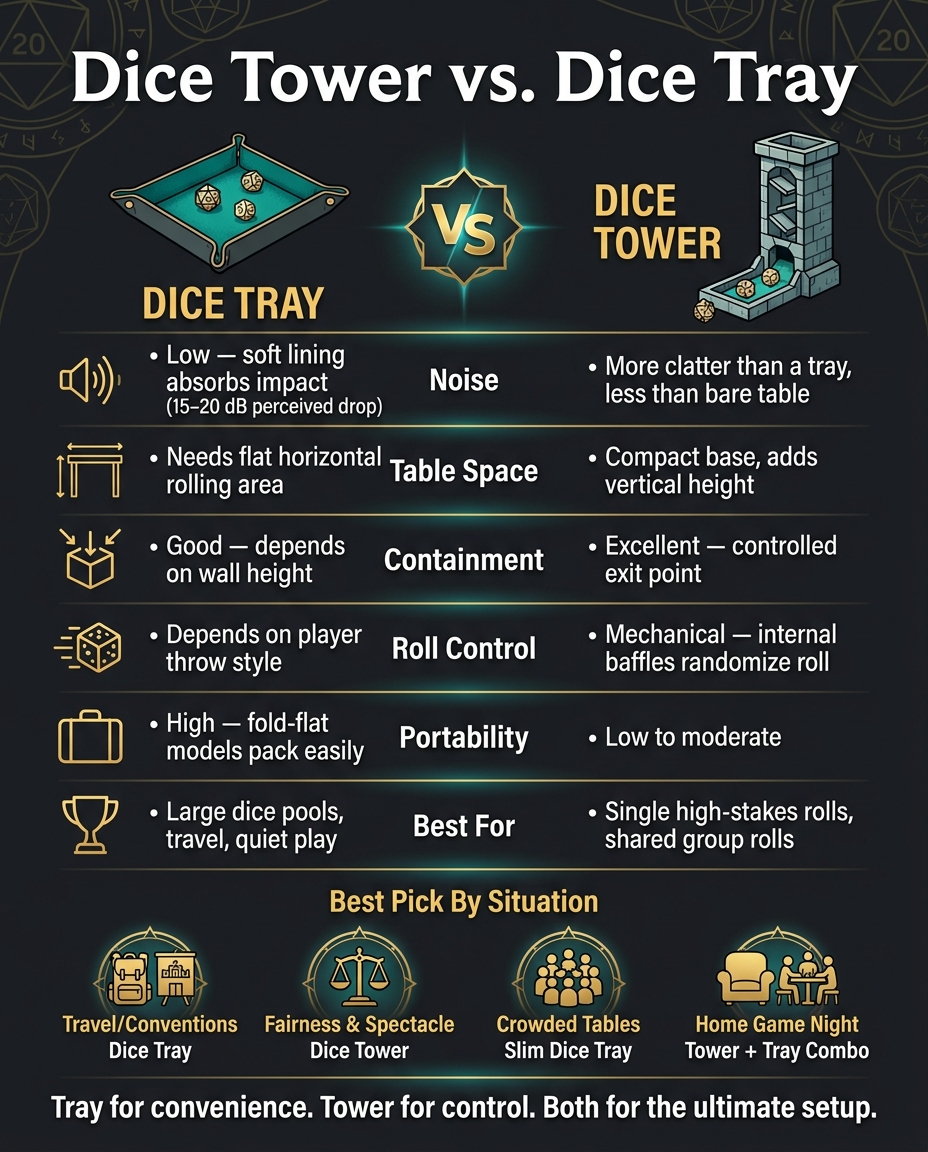
Dice Tower vs. Dice Tray: Quick Comparison Guide for Tabletop RPGs
| Feature | Dice Tray | Dice Tower |
|---|---|---|
| Noise | Low when lined | Softer than bare table, but more clatter than a tray |
| Table footprint | Uses horizontal rolling area | Compact base; takes less surface space but adds height |
| Containment | Good, depending on wall height | Excellent, with a controlled exit |
| Roll control | Depends on the player's throw | Mechanical, through internal baffles |
| Portability | High, especially fold-flat models | Low to moderate |
| Best for | Large dice pools and fast reads | Critical single rolls |
Noise, Table Space, and Dice Containment
A lined tray is usually the quieter pick. Towers still cut down noise compared with rolling on a bare table, but they make more clatter than a tray. In practice, the material changes how soft the landing feels more than anything else.
"A lined tray drops the volume by 15-20 decibels depending on the surface material, which is the difference between 'noticeable' and 'ignorable.'" [4]
Trays also need enough flat room for the kind of rolls you make most often. If you throw a lot of dice, that landing area matters. Higher walls help keep everything in place, which is extra handy with metal dice. Towers make a different trade: they use less horizontal space, but add height. That keeps the base small, though it can get in the way of sightlines across the table.
Roll Control, Fairness, and Reading Results
When it comes to randomization, towers have the edge. The internal baffles tumble the dice and change their orientation on the way down, which takes a lot of human throwing bias out of the roll. That matters most when the group wants a result to feel neutral, quick, and beyond debate. For a big save, a boss attack, or any high-stakes moment, a tower can make that roll feel easier to trust [1].
Trays shine in a different way. If you're rolling a large pool of dice, a tray makes the results easier to read. The dice spread out across the landing zone instead of bunching up, so you can spot totals and patterns much faster.
Portability and Setup Time
Fold-flat snap trays are the easiest to pack and carry. They fit into travel kits fast and don't ask for much setup. Wooden towers and rigid tower-tray combos make more sense for a home table where the gear stays put. Once you start fitting these tools around a DM screen, a player seat, or a bag for game night, those differences become a lot more noticeable.
Which Rolling Tool Fits Your RPG Setup
Once the main tradeoffs are clear, the best pick comes down to where you sit and how you like to roll.
Behind the Best DM Screens
A DM is usually juggling a lot at once: initiative, monster stats, hidden rolls, and the small task of keeping players locked in. In that setup, a dice tray is often the easiest fit. It sits flat next to your notes, takes up less vertical room, and doesn’t get in the way behind the screen. A snap tray stays flat beside your notes and opens fast when you need a roll [2][4].
A dice tower can still make sense when the table wants each roll to feel impartial. It’s a good pick when you want containment and built-in randomization at the same time. And if you like having your gear in one spot, a tome-style command center keeps notes, dice, and initiative tools together [2][3].
That same idea changes a bit at the player side of the table, where space gets tight fast.
Players With Limited Table Space
Crowded dining tables and packed game-store tables don’t leave much room for extra gear. In that case, a slim folding tray is usually the best fit. It gives you a contained spot to roll without taking over the space meant for your character sheet or miniatures [4].
A shared dice tower in the middle of the table can also work well for group rolls, especially when everyone needs to see the result. Just make sure it’s placed where it won’t block anyone’s view [4].
When the table changes from session to session, though, packing and setup start to matter more.
Travel, Convention, and Small-Space Play
For convention games or any session where you’re traveling light, fold-flat snap trays are usually the simplest option. PU leather or vinyl snap trays lay flat, pack easily, and work well in cramped convention spaces [5].
Neoprene rolling mats are another good choice. They roll up small, cover a shared surface, and are easy to wipe clean after a long game day. If you want tower-style randomization while traveling, some collapsible towers fold into a compact box for travel [3]. For DMs carrying a more complete setup, a tome-style command center keeps notes, dice, and initiative tools together in one place [2][3].
Some groups deal with this by using both. When one tool doesn’t handle every need, a mixed setup can make a lot of sense.
Hybrid Setups: Using Both a Tower and a Tray
Sometimes one tool handles only part of the job. That’s where a hybrid setup works well. You get the randomization of a tower and the containment of a tray. The tower mixes the roll. The tray catches it.
Tower Plus Tray Configurations
The most common hybrid setup is simple: a tower that drops into a padded tray. That kind of setup keeps rolls contained and cuts down on scatter. Metal dice land with less impact, which helps protect the table surface. And the result stays right where you need it.
Pick the layout that fits your space, travel habits, and how your group plays.
| Hybrid Layout | Description | Best For |
|---|---|---|
| Tower + Catch Tray | A tower that exits directly into a small, often attached, padded landing zone. | Players with limited table space who want maximum containment |
| Shared Tower + Personal Trays | A single central tower used by all players, while players keep their own rolling trays nearby. | Large groups or shared center-table rolls where everyone needs to see the result |
| Fold-Up Combo | A lightweight tower and tray that unsnap and lay flat for transport. | Convention play and travel setups |
| Integrated Command Center | All-in-one units that combine a tower, tray, and often storage or DM screen elements. | DMs who want a cohesive, organized workflow |
Integrated DM Command Centers
All-in-one command centers push the hybrid idea a step further by folding the tower, tray, and DM screen into one unit [3]. Instead of juggling separate pieces, everything stays in one place. That means less setup and a cleaner table.
WyrmCodex represents this approach as a dragon-forged tome that combines a DM screen, LED dice tower, magnetic command panels, and a campaign journal in one unit.
For most groups, hybrid setups are still a niche pick. In the end, the choice comes down to what matters most at your table.
Final Verdict: Dice Tower or Dice Tray?
Now that the tradeoffs are on the table, the choice comes down to what matters most in your game.
Pick a dice tower if you care most about impartial rolls and that extra bit of table drama. Pick a dice tray if you want something quieter and easier to move around. Fold-flat snap trays are a strong fit for travel, packed tables, and game nights on the road [4][5].
Use the chart below to line up your top need with the right option.
Best Choice by Priority
| Your Priority | Best Pick | Why |
|---|---|---|
| Fairness & spectacle | Dice Tower | Internal baffles remove throwing bias and add a dramatic visual payoff [1] |
| Quiet play | Dice Tray | Soft linings like felt, neoprene, or leatherette absorb impact sound [4] |
| Limited table space | Compact Dice Tray | Can serve as both a rolling surface and a staging area for dice between turns [1] |
| Travel & conventions | Folding Snap Tray | Snap-button designs lay flat for easy transport [4][5] |
| DM organization | Integrated Command Center | Keeps the space behind the screen organized and rolls easy to manage [4] |
If you're a GM who wants one dramatic setup instead of a bunch of separate pieces, an all-in-one command center takes a different path: one piece, one workflow, and everything close at hand.
FAQs
Do dice towers make rolls fairer?
Yes. Dice towers are widely seen as a good way to make rolls feel fairer because the ramps and baffles inside force dice to tumble and bounce off several surfaces before they land.
That cuts down on the impact of throwing style or wrist technique. A dice tray still helps with control and keeps dice contained, but a tower does more to standardize results and reduce disputes.
Which is better for metal dice?
With metal dice, soft padding matters most. It helps protect the dice edges and your table at the same time. A felt-, neoprene-, or suede-lined dice tray works best because it cushions heavier sets and cuts down on noise.
If you use a dice tower, pair it with a soft-lined tray. Also, go with a stable design, since heavier metal dice can make lightweight towers tip or slide.
Should I use both a tower and a tray?
Yes - using both can give you the best of both worlds. The tower brings a bit of drama and mixes up the roll, while the tray keeps dice from skittering across the table and helps protect the surface underneath.
If you’re short on space, an integrated tower-tray unit lets you get both in a single footprint. A modular setup can work well too: use the tray on its own for quick, quiet rolls, then add the tower when the moment calls for something with a little more suspense.