
Most portable DM gear fails for one simple reason: it takes up more space than it saves. When I judge what belongs in my bag, I use 6 checks: size, weight, table footprint, durability, setup time, and job at the table.
Here’s the short version: pick gear for the table you use most, not your ideal setup. If I play at home, I can use heavier gear. If I play at a store or convention, I want gear that packs flat, sets up in seconds, and cuts down on loose parts. In most cases, 3–4 screen panels, 8–10-inch landscape height, and one item that does more than one job are safer bets than bulky add-ons.
What I look for first:
- Fits the venue: home, store, or convention
- Doesn’t eat table space: low-profile gear works better in tight spots
- Holds up to travel: hinges, clasps, and coating matter
- Sets up fast: fold-flat and magnetic gear saves time
- Does more than one job: tracking, reference, and storage in one piece
- Doesn’t duplicate another item: if one tool already covers rolling or notes, I skip the extra one
The core idea is simple: carry less, but make each item work harder. That means screens, towers, trackers, notebooks, and cases should all earn their place before they go in the bag.
The ULTIMATE Minimalist DM Kit! (Ep #346)
sbb-itb-74d578b
Quick Comparison
| Gear Type | Main Check | Best Low-Bulk Pick | Skip It If... |
|---|---|---|---|
| DM Screen | Space vs. control | 3–4 panel landscape screen | It blocks too much table or sightline |
| All-in-One Setup | Fewer loose parts | Screen + storage + tracking combo | Setup takes too long for your venue |
| Dice Tower/Tray | Roll control | Fold-flat tower or built-in tray | Your main setup already handles rolls |
| Tracker/Notebook | Speed during play | Refillable or magnetic tracker | It solves nothing at the table |
| Carry Case | Fit and protection | Backpack or divided DM bag | You need a rolling case for a light kit |
If I keep those checks in mind, packing gets easier and game night runs smoother.
The 6 Criteria to Evaluate Any Portable DM Gear
Run every item through these six checks before you pack it. They work for pretty much everything you might bring to the table: screens, dice towers, notebooks, trackers, and carrying cases.
Size, Weight, and Table Footprint
Size and weight often decide whether a piece of gear comes with you or stays on a shelf. Lightweight materials like cardboard or synthetic leather are easier to slide into a standard backpack, while wood and metal take more effort to carry [4][5]. That tradeoff hits hardest when you’re heading to a game store or convention with a full load already on your back.
Table footprint matters just as much as packed size. Taller portrait-style screens - anything over 12 inches high - give you strong privacy, but they can also feel like a wall between you and your players. Shorter landscape screens in the 8–10 inch range keep things more open and usually work better at crowded tables [5][7]. For store nights and conventions, a compact three-panel screen or another low-profile setup is often the safer pick.
Durability, Setup Speed, and Storage
Once the size looks right, check how well the gear handles repeat travel. If you pack and unpack it every week, wear adds up fast. Start with the hinges, clasps, and joints. Reinforced hinges and heavy-duty magnetic latches tend to last longer through repeated use [5][3]. Water-resistant coatings are also worth a look, especially for public play [5].
Setup speed doesn’t get enough attention. Foldable and magnetic designs that snap open in seconds are worth putting near the top of your list, especially when you’re setting up in public [4]. For storage, built-in features like card slots, clear pockets, and inner compartments can cut down on loose accessories [5][3].
Modularity and Table Function
Once it fits in your bag and holds up on the road, the next question is simple: what does it actually do during play? A tool earns its space by fixing a problem at the table. Modular magnetic panels let you change your reference layout mid-session and attach trackers or reference cards as needed without taking up more space [2][3]. Clear swappable pockets are handy if you run more than one system. Fixed rules are fine for a single game, but swappable inserts make more sense for groups that rotate systems [6][5].
Dry-erase surfaces on panels or built-in tracking areas let you update HP and initiative right on the screen instead of reaching for scrap paper [2][3]. The best portable gear covers reference, tracking, and organization in one piece.
How to Evaluate Each Type of Portable DM Gear
Use the same six criteria for every tool, but don’t weigh them the same way. Start with the tool’s actual job at the table. That tells you what matters and what’s just extra stuff.
DM Screens and All-in-One Command Centers
With DM screens, the first thing to judge is how much table control you get for the space they take up. That’s the main tradeoff. From there, the format affects table footprint, setup time, and how much gear you can leave at home.
Landscape screens keep sightlines more open. Portrait screens give you more privacy, but they block more of the table. Panel count matters too. Three to four panels tends to be the sweet spot: enough room for notes and references without taking over the whole play area[6][5].
Then comes the big choice: static or modular.
Screens with transparent swappable pockets let you change reference sheets between systems[6]. Magnetic modular setups take that a step further. You can add or remove panels and accessories based on the session you’re running[2][6][5]. That kind of flexibility can be handy when one night is heavy combat and the next is mostly roleplay.
All-in-one tome designs roll several jobs into one object. WyrmCodex is a good example. It combines a screen, dice control, and storage into one command center. That means fewer loose accessories in your bag. The downside is simple: setup is slower than with a plain cardboard screen. Still, if you like having everything in one place, the payoff is better table organization.
If your screen already handles notes and reference cards, skip separate accessories that do the same job.
Dice Towers, Trays, and Roll Control
A dice tower should earn its spot by doing two things well: controlling the roll and keeping dice from flying everywhere.
For portable play, one spec matters more than almost anything else: does it fold flat? If it doesn’t, it’s hard to justify for a mobile kit. Fold-flat or skip it[4]. And if your all-in-one setup already has a built-in tower, bringing another one is just duplicate gear.
A tower and tray combo can make sense on hard-surface tables. The tower guides the roll. The tray catches the dice and cuts the noise[4]. On a wooden table, that difference is easy to notice. In quieter places like cafés or hobby stores, it can be the difference between a clean setup and a clattery mess.
If your screen or command center already includes dice control, don’t pack a second roll system.
Campaign Notebooks, Card Binders, Trackers, and Mini Toolkits
For this group of tools, the test is pretty simple: does it fix a real problem that slows your game down?
Initiative trackers and condition rings usually pass that test with no trouble. They speed up combat and cut down on rules lookups[1]. A magnetic tracker can keep initiative visible without eating table space, which is a nice bonus.
Spell card books help keep spell references in order and off the table surface[8]. For notes, a refillable ring-bound journal makes more sense than a fixed notebook because you can swap in new pages instead of replacing the whole thing. If your screen already has a built-in journal, that’s one less item to carry.
Pack the tools that solve actual table problems. Leave the rest in the drawer.
Once the main tools are picked, the next step is to match the kit to the table you actually run.
Build Your Portable Kit Based on Where You Run Games
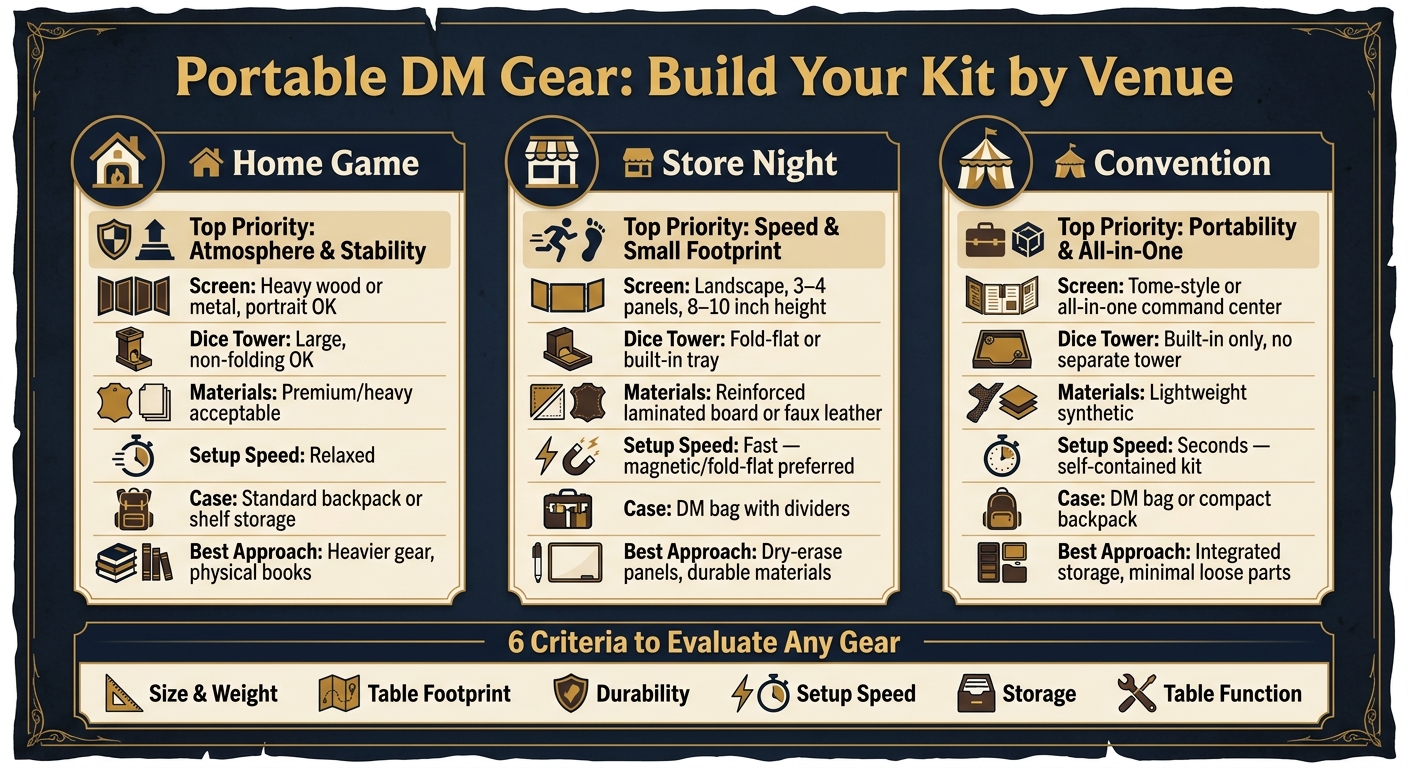
Portable DM Gear: 6 Criteria Checklist by Venue
Home Sessions vs. Store Nights vs. Conventions
With those points in mind, build your kit around the table you actually use. A setup that feels perfect at home can turn into dead weight at a convention.
Home games give you the most room to work with. Since you control the space, heavier gear can be worth bringing out. A solid wood or metal screen, a large dice tower, and the books you use most can all make sense here.
Store nights shift things fast. Tables are shared, space is limited, and setup has to be fast. A landscape-oriented screen helps keep your footprint small [6]. Dry-erase panels make initiative and HP tracking easier once combat starts moving fast [3]. Material matters too. Reinforced laminated board or faux leather tends to hold up better during travel and the occasional spill [5].
Conventions favor the smallest, most self-contained kit you can put together. This is where all-in-one tools shine. A self-contained setup helps keep your core gear together as you move from room to room [3].
| Venue | Top Priority | What to Favor |
|---|---|---|
| Home Game | Atmosphere & stability | Heavier screens, large dice towers, physical books |
| Store Night | Speed & small footprint | Landscape screens, dry-erase panels, durable materials |
| Convention | Portability & all-in-one | Tome-style setups, integrated storage, minimal loose parts |
Build Your Core Kit, Add Extras, and Pick a Carrying Case
Once you know the venue, cut your bag down to what you actually need. Start with the basics: a dice set, your core reference, a screen, and a tracker for NPCs and initiative [1]. That’s the core kit. Everything else is optional until it fixes a problem at your table.
Add extras only when they earn their place. If dice trays, condition rings, or initiative trackers help remove friction, bring them [1][8]. If not, leave them out. A good rule is simple: add one new tool only when it solves a real problem.
After that, pick a case that matches the size and weight of your kit. A standard backpack is enough for cardboard screens, a notebook, and a tablet. A DM bag with custom dividers gives more protection for modular gear and keeps dice from sliding around in transit. A rolling case makes sense only if you’re carrying heavy hardwood screens or a large physical library [5][3].
| Case Type | Capacity | Protection | Best Fit For |
|---|---|---|---|
| Standard Backpack | Low–Mid | Basic padding | Cardboard screens, notebooks, tablets |
| DM Bag | Moderate | High, custom dividers | Modular screens, dice, integrated storage |
| Rolling Case | High | Maximum | Heavy wood screens, full physical libraries |
Carry only what the table needs.
Conclusion: Pack for Function First, Then Atmosphere
Once the tradeoffs are out in the open, the rule is pretty simple: function comes first. Pack gear that helps you set up fast, fits your table, and makes the game easier to run. Use the six checks to pick gear that earns its spot.
Most DMs tend to fall into two camps. Some like a lightweight modular approach: easier to carry, fewer moving pieces, and a kit that slips into a standard backpack. Others want a more unified setup. For those DMs, an all-in-one command center like WyrmCodex can make sense, with an integrated setup and fewer loose accessories.
Pick the form that matches your table, your travel, and your pace. The right kit should fit the way you run games and the places where you play.
FAQs
How do I choose gear for small tables?
When you’re working with limited space, multi-use gear makes a big difference. Go for pieces that do more than one job without taking over the table. Landscape-oriented screens help keep sightlines open, which can make a cramped setup feel less boxed in. Modular or transforming designs are also a smart pick, since they can bring your screen, trackers, and storage together in one compact setup.
A dedicated dice tray helps keep rolls contained instead of bouncing into books, minis, or someone’s drink. And with customizable inserts or magnetic panels, you can keep only your most needed rules and references on the table. That way, the setup stays clean, focused, and easier to manage.
What portable DM gear is actually essential?
Portable DM gear should do three jobs well: help you run the game, keep your stuff organized, and travel without turning into a mess.
At the bare minimum, every DM needs a reliable set of polyhedral dice and a way to track campaign notes, whether that’s a notebook or a digital document.
For in-person games, a foldable DM screen helps a lot. Many DMs also bring a few small tools that make play smoother, like initiative trackers, condition cards, and dice trays or towers. On top of that, durable organizers help keep everything protected, packed neatly, and ready to go.
When is an all-in-one setup worth carrying?
An all-in-one setup makes a lot of sense when you need to balance organization with the usual chaos of travel. It’s a strong fit for Game Masters who run sessions in stores, at conventions, or at friends’ homes, where fast setup and teardown can make the whole night smoother.
When you bring core tools together in one portable unit - like initiative trackers, reference tables, storage, and dice towers - you spend less time juggling gear and more time running the game. It also cuts down on table clutter, which helps keep things clear and the session moving.