
A smooth session usually comes down to 7 simple tools: a DM screen, initiative tracker, dice tray or tower, campaign journal, rule sheet, condition markers, and table organizers.
I’d sum it up like this: if I can see turn order, find rules in seconds, and keep the map clear, the game runs with fewer stops. That matters because combat often slows down over small issues like lost notes, forgotten conditions, and dice rolling into minis.
Here’s the full list at a glance:
- DM screen for private notes, stats, and fast rule checks
- Initiative tracker so players know when they’re up
- Dice tray or tower to keep rolls in one place
- Campaign journal for quests, NPCs, and session notes
- Rule references for combat, conditions, saves, and spells
- Condition markers to show status effects on the map
- Organizers and side storage to stop table clutter
The main idea is simple: each item should fix one common table problem. If it doesn’t help pace, visibility, or space, I wouldn’t keep it on the table.
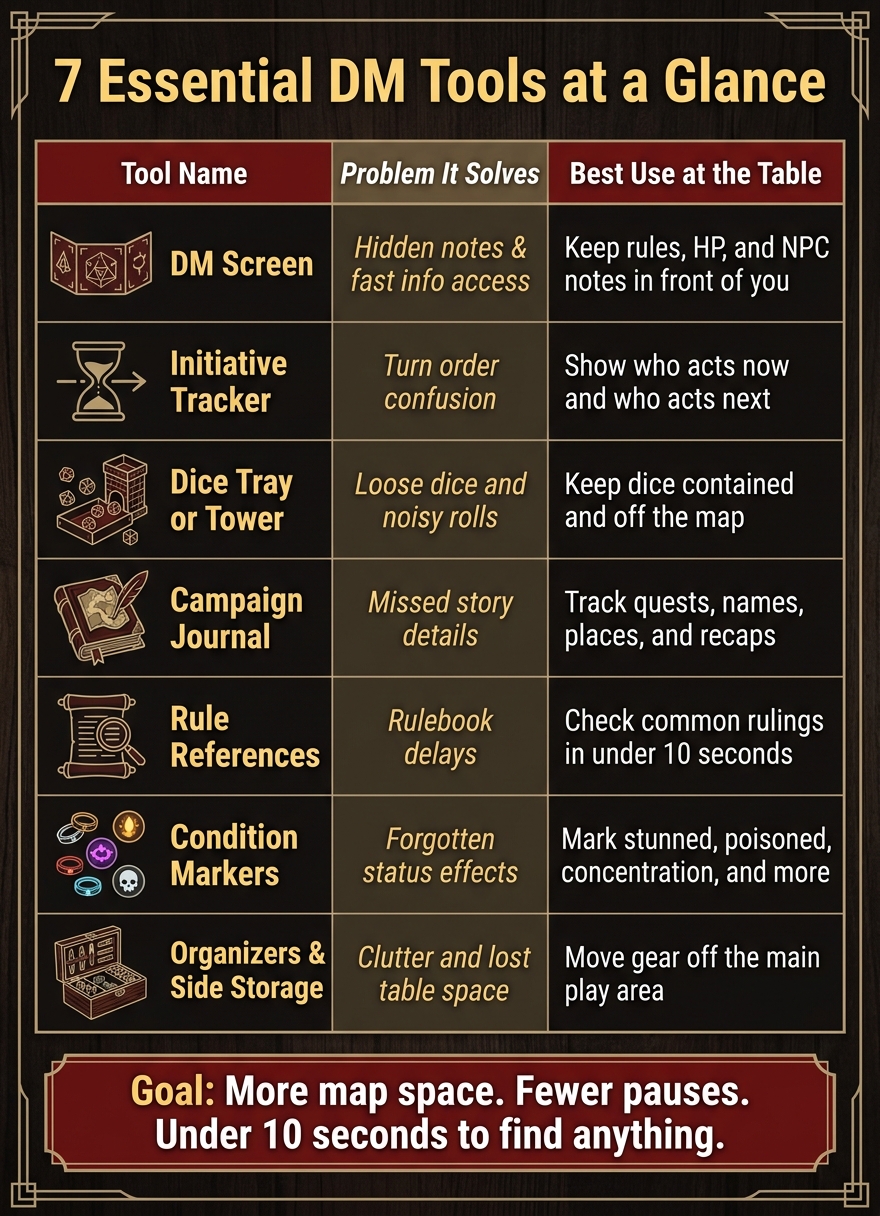
7 Essential DM Tools: What They Fix & How to Use Them
Setting Up Your Gamemaster's Screen! (GM Tips w/ Matt Mercer)
sbb-itb-74d578b
Quick Comparison
| Tool | What it helps with | Best use at the table |
|---|---|---|
| DM screen | Hidden notes and fast info access | Keep rules, HP, and NPC notes in front of me |
| Initiative tracker | Turn order confusion | Show who acts now and who acts next |
| Dice tray or tower | Loose dice and noisy rolls | Keep dice contained and off the map |
| Campaign journal | Missed story details | Track quests, names, places, and recaps |
| Rule references | Rulebook delays | Check common rulings fast |
| Condition markers | Forgotten status effects | Mark stunned, poisoned, concentration, and more |
| Organizers and side storage | Clutter and lost space | Move gear off the main play area |
A good target is simple: more space for the map, fewer pauses for admin, and less than 10 seconds to find what I need.
The Core Command Center: Screen, Initiative, and Dice Control
Start with the tools that keep the table under control and easy to read.
The DM Screen as Your Table Anchor
A DM screen does more than hide your notes. It keeps notes, NPC stats, hit points, and secret rolls out of sight. On your side, quick-reference charts for conditions, DC guidelines, and common combat actions help you avoid flipping through a rulebook in the middle of an encounter.
Landscape screens stay lower and keep sightlines open. Taller screens give you more privacy. Tome-style designs turn the screen into a larger command center. WyrmCodex is a dragon-bound tome that opens into a command center with screen panels, magnetic surfaces, a journal, and a dice tower. Whatever format you pick, put stability first. A steady screen protects privacy and helps the session keep moving.
Once the screen is in place, the next thing to pin down is turn order.
Initiative Trackers That Keep Combat Moving
Turn order is easy to lose track of, and when it slips, combat can bog down fast. A visible tracker helps players stay ready for their turn. Clip-on cards, magnetic name plates, and dry-erase strips can all do the job. Magnetic strips are the fastest to reorder, while dry-erase strips make it easy to add conditions or HP. If your screen has magnetic command panels, those surfaces can double as an initiative rail without taking up more table space.
With combat order out in the open, the last piece of the command center is keeping rolls in one place.
Dice Trays, Towers, and Dedicated Roll Zones
Loose dice can throw off the flow of a session. They hit minis, slide under books, and sometimes vanish off the table. Every time that happens, attention shifts away from the game.
A dice tray keeps rolls contained and helps protect the table from heavy metal dice. A dice tower also keeps rolls contained, while adding a clean reveal. For the DM, a dedicated roll zone behind the screen lets you make secret rolls without giving anything away. Felt-lined trays cut noise. Wood and metal trays hold up well over time.
"Dice trays and towers deserve a special mention. They keep dice on the table (not the floor), muffle that 2 a.m. clatter, and honestly just feel satisfying to use." - 1985 Games [3]
An integrated tower saves space and gives critical rolls a bit more presence.
After rolls are under control, the next layer is tracking the small details that shape rulings and continuity.
The Information Layer: Notes, Rules, and Condition Tracking
Once the table is under control, the next layer is memory: notes, rules, and visible status.
Campaign Notes and Session Journals
Use a refillable journal or binder to track active quests, key NPCs, locations, consequences, and session recaps. As the campaign shifts, you can move pages around instead of fighting a notebook that no longer fits the story.
With the story tracked, the next job is making rulings faster.
Rule References for Faster Rulings
Keep the rules you use most on a slim sheet or card: combat actions, conditions, saving throws, spellcasting, concentration, improvised damage, and key stats like AC, HP, and passive Perception [6][2][7]. A handy panel setup puts combat conditions in the center, spellcasting and saving throw rules on one side, and NPC or encounter notes on the other [6].
If your screen has magnetic surfaces or clear pockets, swap reference sheets in and out based on the session. For an overland trip, that might mean wilderness travel rules instead [6][4].
When the rules are right there, condition markers help everyone see how those rulings play out.
Condition Markers and Status Visuals
Conditions are easy to lose track of in combat. Use rings, tokens, or magnetic markers so stunned, poisoned, and concentration effects stay visible to everyone. Colored rings that clip onto miniatures, acrylic tokens, or magnetic markers all handle this neatly. Color-coding by group - one color for the boss, another for minions - makes it easier to run multiple enemy types without mix-ups [5]. Visible status keeps initiative honest and decisions fast.
"The most valuable square footage at the table is the map. Everything else has to justify taking space from it." - Black Lantern Forge [1]
Stick with small, stackable markers. If a marker is bulky enough to crowd the map, it starts causing the same problem it's supposed to fix.
The Setup That Prevents Clutter
Modular Organizers, Storage, and Vertical Layout
Once your core tools are set, the last step is simple: keep the table clear.
That’s where many setups start to fall apart. Pens slide under the monitor. Tokens get mixed in with dice. Encounter sheets stack up on top of the battle map. Before long, the whole space feels cramped.
The best fix is to build up, not out.
Think of your DM screen like a command wall. Magnetic pouches on the inside can hold pens and dry-erase markers upright. Clip-on document holders keep encounter sheets in view. A top-rail initiative tracker shows turn order without eating up table space. When you move those tools onto the screen and off the table, you give the map the room it needs.
After that, shift the rest of your extra gear to a nearby overflow spot. Items you don’t need all the time, like spare dice, extra tokens, mini boxes, and campaign binders, don’t need to live on the main play surface. A side table, the chair next to you, or an open bag within arm’s reach works well. You still have access to everything, but the table stays usable.
Labeled binders and map folders also help stop that slow spread of gear across a long campaign. You know the pattern: one loose sheet becomes a stack, then a pile, then half the table is gone.
Every few sessions, do a quick reset. If something isn’t fixing a current problem, it doesn’t need to be on the table.
Clear surface. Close tools. Space for the map to breathe.
Conclusion: Build a DM Table That Runs Smoothly
Seven tools. One goal: a table that runs without friction.
A DM screen, initiative tracker, dice tray or tower, campaign journal, rule references, condition markers, and modular organizers each fix one thing that tends to slow a session down. Put together, they help you spend less time sorting, searching, and stopping. More of your attention stays on the game.
You can build this setup one piece at a time. Add each item when it fixes a problem you’re already dealing with at the table. If you’d rather go with an all-in-one option, WyrmCodex offers a dragon-tome setup that brings together a DM screen, dice tower, magnetic panels, and campaign journal in one piece.
Either route gets you to the same place: faster rulings, a cleaner table, and a better session.
FAQs
What should I buy first?
Start with the basics: a rulebook, polyhedral dice, character sheets, pencils, and paper.
When you’re ready to DM, put a good DM screen at the top of your list. It works as your command center for combat, fast rule lookups, and hidden notes. From there, you can add battle mats, markers, dice towers, or initiative trackers as handy extras.
Can I run a good game without all seven tools?
No - you don’t need all seven tools to run a great game. A Dungeon Master’s kit should match your style and the way you run the table, kind of like packing for a trip: bring what helps, skip what doesn’t.
Plenty of DMs do just fine with the basics - rulebooks, dice, and a few simple notes. Everything else is there to make life easier. The best setup isn’t the one with the most gear. It’s the one you’ll use, so the game stays smooth and your attention stays on the story.
How do I keep my DM table from getting cluttered?
Keep your must-have gear in one dedicated bag. It makes setup faster, cleaner, and a lot more consistent from session to session.
Your DM screen should be the heart of your setup. A modular screen works especially well because it lets you hide notes, maps, and monster stats while keeping rules where you can glance at them without breaking the flow.
It also helps to add a few tools that cut down on table clutter. Initiative trackers, condition rings, and a dice tray or tower can save you from the usual pile of loose bits sliding around the table.
Magnetic panels or clips are handy too. They can hold handouts and spell cards in place instead of letting them drift into the chaos. If you want something more all-in-one, WyrmCodex folds a screen, dice tower, and journal into one transforming tome.