
Good loot prep comes down to six things: plan rewards, total coin, prep item handouts, split consumables from long-term gear, tag clue and faction rewards, and log what the party did or did not get.
If I do those steps before game night, I spend less time digging through notes and more time running the table. The article’s core point is simple: keep every reward in one place, mark its source, and track its result during play. Even a short loot plan can cut missed rewards and note confusion by a lot.
Here’s the full session-prep checklist at a glance:
- Set reward goals for the session
- List each loot source by room, encounter, quest, or hoard
- Add coin totals with clear number formatting like $1,250 or 1,250 gp
- Prep magic item cards with only table-use rules
- Keep consumables separate from permanent gear
- Flag player wish-list matches
- Attach clues to treasure entries
- Note faction gifts and the standing needed
- Set up a journal page for planned, found, and missed loot
- Do one last pre-session check before play starts
A short tracking habit helps a lot here. For example, using just 3 status labels - claimed, missed, and deferred - makes loot easier to follow from start to finish.
This article is a plain session-prep guide for DMs who want loot to be easy to run, easy to hand out, and <u>easy to record after the session</u>.
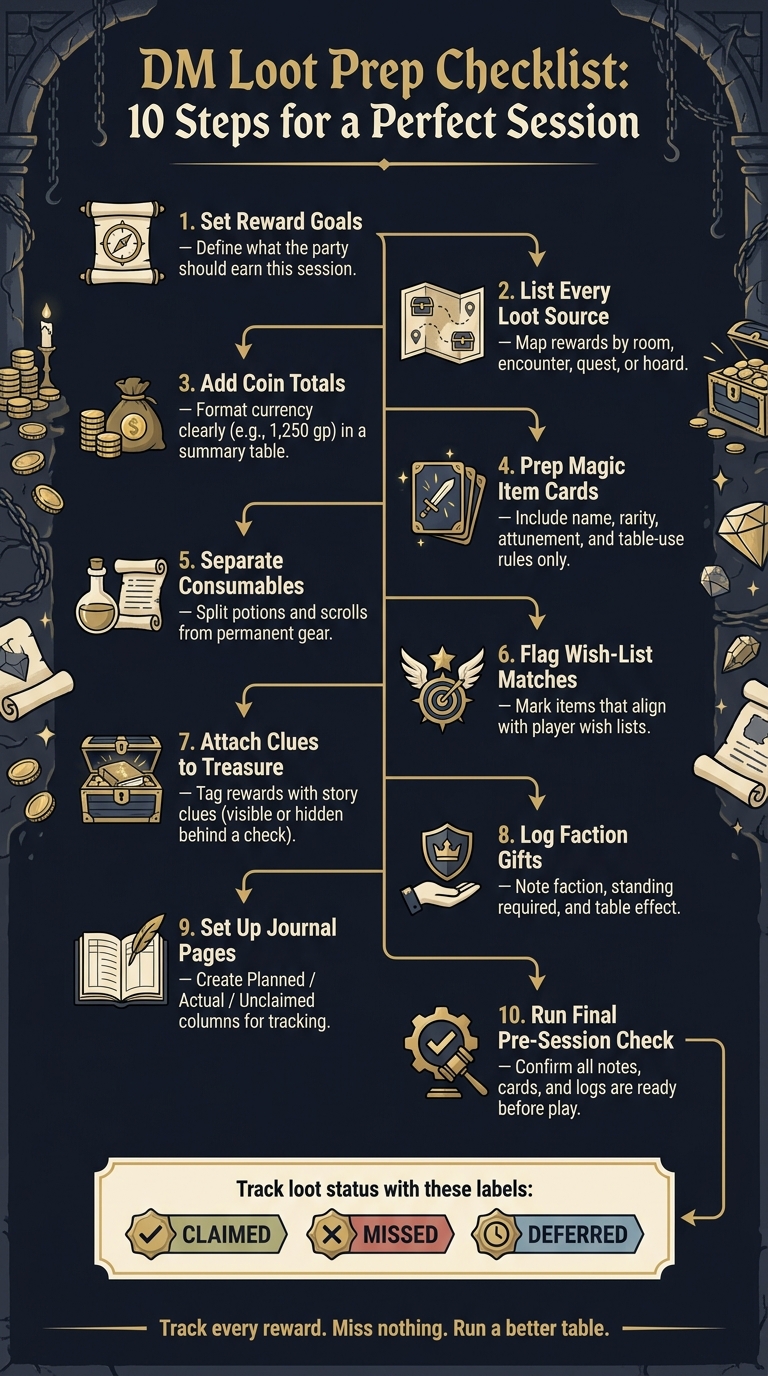
DM Loot Prep Checklist: 10 Steps for a Perfect Session
Treasure notes and currency totals checklist
Write encounter-by-encounter treasure notes
Once the session's reward goals are set, put every loot source in one spot. For each encounter, room, quest payout, or hoard, write down where it comes from and how much it is.
That way, you don't have to stop mid-session and think, “Wait, did the party already find that stash?” Everything is right there when you need it.
Add a session currency summary
Format currency with commas for thousands, like 1,250 gp, so totals stay easy to scan at the table [1].
A simple table works well for this [1]:
| Source | Amount | Status |
|---|---|---|
| claimed, missed, or deferred |
Mark each row as claimed, missed, or deferred during play.
sbb-itb-74d578b
Magic item cards, consumables, and player wish-list notes
Prepare magic item cards before the session
Once you've handled coin totals, get the physical rewards ready for the table. For each magic item the party might find in this session, write or print a simple card.
Include only what players need in the moment:
- Item name
- Rarity
- Attunement requirements
- Rules text needed to use the item at the table
Skip the lore. Stick to mechanics only. Then keep the cards behind your screen or tucked into your journal pocket so you can hand one over the second the party finds it.
Separate consumables from permanent rewards
Next, split one-use rewards from items the party keeps for the long haul. Put potions, scrolls, and other one-use items in a separate pile or list.
It sounds small, but it saves headaches. You don't want consumables getting mixed in with permanent rewards, especially when players are sorting loot on the fly. It also helps control reward pacing and avoids sudden jumps in party power.
Cross-check player wish lists
Finally, mark any reward that lines up with a player's stated wish list. That way, when the moment comes, you can hand out the right item fast without flipping through notes.
Clue-linked rewards and faction gift checklist
Attach clues to treasure drops
Use your treasure notes to mark which rewards also carry clues.
Gold and magic items make the party stronger. Clues do something different: they add tension now and pay off later in the story. So for each major treasure cache in your session, ask: What story clue comes with this loot?
A letter inside a chest can hint at a villain's motive. A sigil stamped on a coin pouch can connect the treasure to a faction or a larger movement. A hand-drawn map tucked into a scroll case can point the party to a place they haven't found yet. The easiest way to handle this is to add clues as tags to treasure entries. You get instant flavor at the table, and later those same details can push the plot forward.
Mark each clue as visible in the loot or hidden behind a check. That small note can save a lot of confusion during play.
Plan faction gifts and reputation rewards
Faction gifts - titles, safe passage, and restricted access - can matter just as much as loot. They belong in the same prep pass as treasure, not off in the margins as a side note.
For each one, write down:
- The faction
- The standing needed to unlock it
- The table effect
That way, when the party earns trust, you already know what opens up for them.
Reward type comparison table
Use this table as a quick reference when you decide how to balance your session's reward mix:
| Reward type | Short-term usefulness | Long-term story value | Tracking effort |
|---|---|---|---|
| Gold and items | High | Medium | Medium |
| Faction gifts | Medium | High | Medium |
| Clue-based rewards | Low to Medium | High | Low to Medium |
Log the reward types you picked in your journal before the session starts. Record the mix now, then move it into your session log.
Journal logging and final pre-session loot check
Set up journal pages for expected and actual loot
Once the reward list is locked in, use your journal to track what actually happens at the table. A simple three-column layout works well:
- Planned: every reward you expect to drop
- Actual: what the party found
- Unclaimed/Moved: loot that was missed or shifted elsewhere
It also helps to log used consumables apart from permanent magic items. That way, inventory stays clean and accurate from one session to the next.
Run the final session-ready checklist
With the log page set, do one last table check before play starts.
Before play, run this checklist:
- [ ] Loot notes and currency totals ready
- [ ] Item cards and consumables sorted separately
- [ ] Player wish-list matches flagged for handout
- [ ] Clue-linked rewards tagged and ready
- [ ] Faction gifts and reputation rewards logged
- [ ] Journal pages set up for expected and actual loot
Keep your notes, dice, and journal within reach so loot tracking stays fast and easy at the table.
Conclusion: Core loot prep points to review every session
Before play, confirm the loot list, handouts, and journal pages. After play, log what was claimed, missed, or moved.
Prep Your Next D&D Game in Only 30 Minutes
FAQs
How detailed should my loot prep be?
Keep your loot prep focused and loose, not packed with tiny details. Set up a small batch of rewards that tie back to the story - treasure, information, or leverage - and drop them in where they make the most sense during play.
Skip rigid scripts. Instead, jot down a few clear rewards, the exact items or cash involved, and any clues that might come with them. Then note the rough place they might show up or the situation they’re meant for.
What if the party misses important treasure?
Treat your prepared treasure as movable, not locked to one route. If the party misses it, bring that loot back in a later encounter or place it somewhere else they’re likely to visit.
Prepared material only goes to waste if you abandon it. When rewards aren’t tied to one spot, it’s much easier to drop the items, or clues that lead to them, into another room, a later quest reward, or a new NPC scene.
How do I balance loot with story rewards?
Treat treasure as part of the story, not something you tack on at the end. The best rewards feel tied to what just happened at the table: a faction contract that pays out after a hard job, a quest reward that lands at the right moment, or a clue tucked inside a villain’s belongings.
It also helps to keep a player wish list and a simple tracker for who got what, plus total gold. That way, rewards stay personal and balanced without turning into guesswork. You can also log clues or bits of lore alongside those rewards. If the party skips an encounter, you can move that item or clue somewhere else without it feeling forced. The result is loot that feels personal, flexible, and earned.