
You don’t need a big budget to make your game room feel like part of the story. In most home games, just one strong cue per scene - sound, light, a prop, NPC delivery, or a clean DM setup - can change how fast players lock in.
I’d boil the article down like this:
- Use ambient sound first because it changes the room in seconds
- Swap harsh ceiling light for warm, focused light so the table feels less flat
- Hand players something physical like a note, card, or map overlay
- Give NPCs one voice cue and one clear trait so they stick in memory
- Keep my DM area organized so the pace doesn’t stall
The main point is simple: more stuff does not mean a better session. The article keeps coming back to one idea: pick one main cue for each scene, keep it readable and easy to hear, and let the room support the game instead of getting in the way.
A few fast facts stand out:
- Entry cost can be as low as $0 to $30
- A Bluetooth speaker can run about $20 to $150+
- Smart lighting often starts at $100+
- DIY handouts can cost under $1 each
- The setup works best in small U.S. home spaces like dining rooms and basements
How Do You Cultivate Atmosphere at Your D&D Table?
sbb-itb-74d578b
Quick Comparison
| Method | Main job | Low-end cost | Best use |
|---|---|---|---|
| Ambient music and sound cues | Set mood fast | $0 | Taverns, dungeons, combat shifts |
| Smart lighting | Change how the room feels | $0 to $100+ | Warm scenes, tense scenes, night play |
| Props and handouts | Add a physical layer | Under $1 to $20+ | Clues, loot, maps |
| NPC voices and presence | Make characters stand out | $0 | Social scenes, quest givers, villains |
| DM command center | Keep pace and notes under control | Premium | Rules, initiative, scene flow |
My takeaway: if I wanted the fastest win, I’d start with low-volume ambient audio, then add warm lighting, then bring in one physical prop when it fits.
That’s the full idea of the article in plain terms: small sensory changes can make a D&D session feel more like a place and less like a room.
What 'Atmosphere' Actually Means at the Table
Atmosphere is the mix of sensory cues and table habits that helps players feel like they're in the world, not just sitting around it. It comes from light, sound, props, and the small rituals that kick off a session.
At the table, the main tools are light, sound, and touch. Scent is optional. A warm lamp, a low-volume ambient loop, and a tactile handout can make an ordinary room feel very different. Heavier dice and thicker paper add a sense of physical weight. You don't need to spend a lot of money here. What matters is using these cues on purpose.
That said, more isn't better. These cues work best when they support one scene at a time, not the whole session all at once.
A few ground rules help:
- Keep lighting bright enough to read character sheets and see dice.
- Keep sound low enough that people can still talk with ease.
- Use candles or LED candles only when open flames are safe.
The simplest way to do this is to pick one dominant cue per scene. Let the room support play without getting in the way. Start with one anchor, then build from there. For most groups, sound is the easiest place to begin.
1. Use Ambient Music and Sound Cues
Ambient sound can change the table’s mood fast. Before anyone rolls, it can hint at location, danger, and pacing. Even a single loop that fits the scene can do the job.
You don’t need much to get started. A Bluetooth speaker and a free ambient tool are enough. Pocket Bard and Spotify make playlist switching easier, which helps when the scene turns on a dime.
Once you have the tools, sort them by scene. A simple setup is the three-playlist system: one loop for safe, warm places like taverns and cities, one for uneasy spaces like dungeons and wilderness, and one faster track for combat. Those three playlists cover most situations, and switching between them should be quick enough to keep the game moving.[5]
Silence helps too. Cut the music right before a reveal, or let it drop after a big moment. That sudden quiet can make the room feel heavier.
Skip tracks with lyrics or well-known themes. They tend to pull people out of the scene. Instrumental loops work better, whether that’s orchestral music, folk, or ambient drone. Keep the volume low so people never have to talk over it.
Once sound is in place, use lighting to shape what the table sees.
| Tool | Cost (USD) | Best For |
|---|---|---|
| Tabletop Audio | Free | Scene ambience |
| YouTube Playlists | Free (with ads) | Long background loops |
| Pocket Bard | Free to paid plans | Combat or scene shifts |
| Spotify | Free (with ads) to ~$10–$15/mo | Curated ambient playlists |
| Bluetooth Speaker | $20–$150+ | Clear audio for the whole table |
2. Shape the Room with Smart Lighting
If sound sets the mood, lighting shapes the room. Bright overhead lights keep everything stuck in daytime mode. That's fine for reading, but once the game starts, it can feel flat and a little distracting [3].
You don't need to buy much to fix that. Start with the lamps you already have. Turn off the overhead lights and point one or two warm lamps toward the table. That pulls attention to the map, the dice, and the faces around it [3].
Color does a lot of work here. Warm amber light feels safe and familiar, like taverns, hearths, or a friendly inn. Cool or blue light leans toward tension, danger, or mystery [3]. Want a low-cost change? Drape thrift-store silk or cloth over a lamp to tint the light. If you want to swap scenes fast, smart bulbs or light strips make that much easier [5][6].
The main thing is balance. Keep the table bright enough for people to read their character sheets and see their dice. And shift the lighting slowly. Sudden blackouts can feel staged instead of immersive [3].
| Lighting Option | Approx. Cost (USD) | Best For |
|---|---|---|
| Repositioned household lamps | $0–$20 [6] | Instant warmth, no new gear |
| Thrift-store fabric or silk masking | $0–$20 [6] | Simple color shifts on existing lamps |
| LED candles or small accent lights | $20–$60 [6][7] | Safer ambience and dramatic shadows |
| Smart bulbs or colored light strips | $100+ [5][6] | Fast, app-controlled scene changes |
Once the room is lit, add tactile details players can hold.
3. Add Props, Terrain, and Handouts Players Can Touch
After sound and lighting, props add a physical layer to the mood. They work in a different way because players can hold them in their hands.
A weathered handout is easy to make. Print the clue, crumple the paper, stain it with coffee or tea, then tear the edges once it dries.
Item cards are great for loot. Write the item name, a one-line description, and the key stats on an index card, then pass it to the player. That small handoff makes the reward feel more real. [5]
Small story props can have the same effect. A silver comb or a cursed skull can change the feel of a scene fast. [1]
For maps, put a clear plexiglass overlay or dry-erase sheet over the battle map. Players can mark routes and track movement without ruining the original. [3]
Use terrain when scale, cover, or danger matter. [5] If a prop needs more than one quick handoff to explain, skip it.
Once players can touch the world, the next layer is how the people in it sound.
| Prop Type | Prep Time | Est. Cost (USD) | Best For |
|---|---|---|---|
| Weathered handouts | ~5 minutes [5] | <$1 [5] | Clues, lore drops, quest hooks |
| Item/stat cards | 1–2 minutes [5] | <$1 [5] | Artifacts, potions, special loot |
| Plexiglass map overlay | One-time setup | ~$20+ [3] | Interactive mapping and tracking |
| Narrative objects | Minimal | Varies | Emotional beats, specific NPC items [1] |
4. Bring NPCs to Life with Voices and Table Presence
Once players can feel the world around them, the next step is simple: give them people who feel just as real.
A good shortcut is to give each NPC one clear voice cue. Maybe they sound gruff, rushed, clipped, or warm. Then pair that with one small idea about what they were doing before the party showed up. That tiny bit of context goes a long way. An innkeeper wiping down mugs feels different from one who just ran in from the rain.
For major NPCs, keep it tight. Give each one one goal and one trait - maybe suspicious, eager, or exhausted. Let those two things shape how they talk, how they hold themselves, and how fast they respond. You don't need a full character study. A couple of strong signals usually does the job.
Character anchors can help a lot here. Pick one prop that belongs only to that character, then grab it when you step into the role. That small move creates a cue for you and for the table, which makes the NPC easier to remember. [4]
If you want voice shifts to happen fast, keep a few simple reference tools close by:
| NPC Prep Tool | Prep Effort | What It Does |
|---|---|---|
| Roleplay cheat sheet | Low | Quick reference for voice, tone, and goal in this scene [3] |
| Character anchor (reserved prop) | Low | Triggers character headspace and makes the NPC easier to remember [4] |
You can also switch your posture, stance, or even your seat position to show that a different character is speaking.
5. Turn Your DM Screen into a Command Center with WyrmCodex
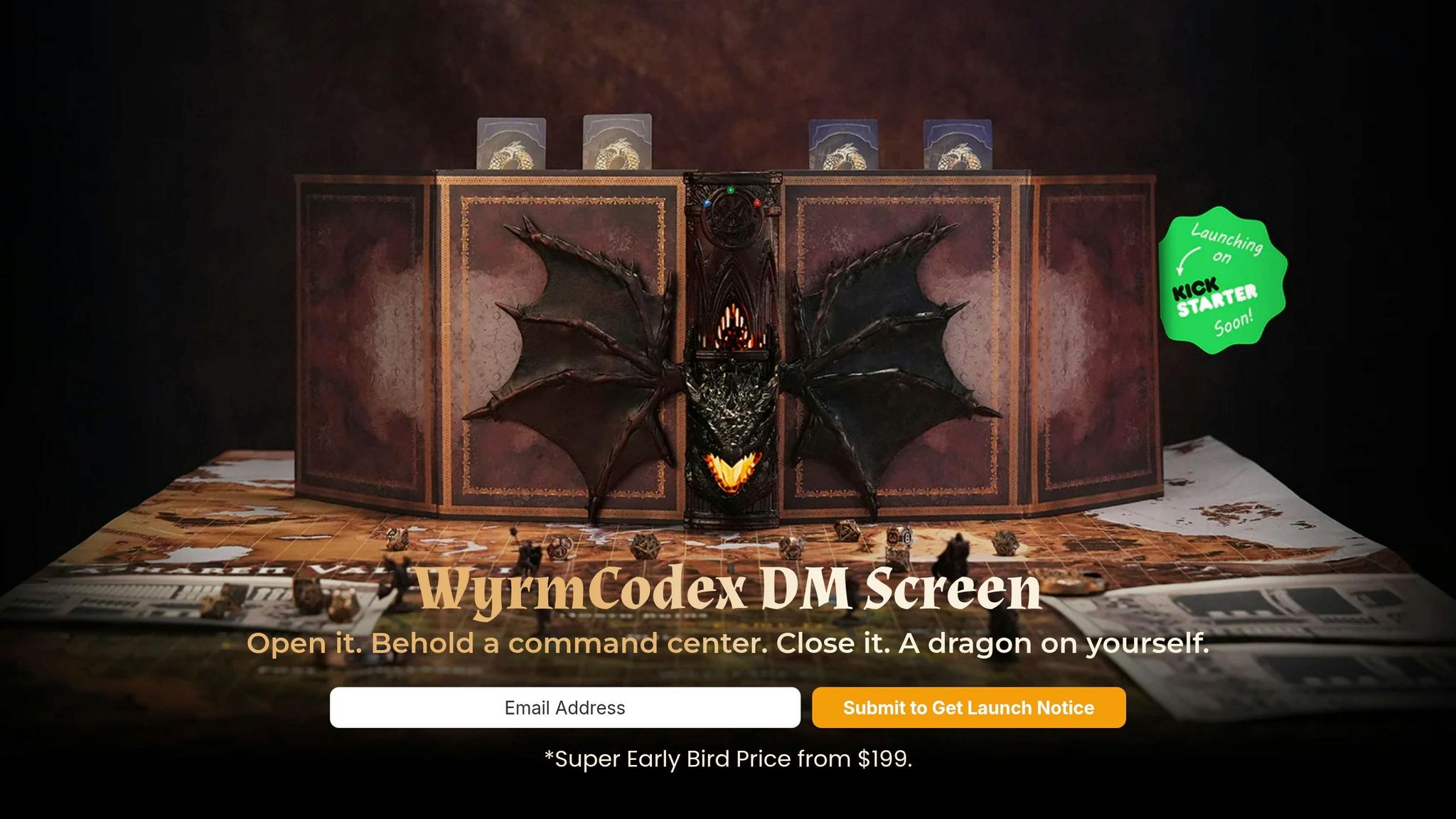
A clean DM area keeps the game moving. That matters because even great sound and lighting can fall apart if the DM side of the table is a mess.
WyrmCodex is a dragon-forged DM tome that opens into a DM screen, LED dice tower, magnetic command panels, and a refillable campaign journal. The main draw isn't just storage. It's keeping the pace of the scene intact. When a rule, note, or table takes too long to find, the moment slips. WyrmCodex gives initiative cards, NPC notes, and backup tables a set place, so you’re not digging through loose papers right when the pressure hits.
The screen itself can also help set the tone. The LED tower adds one dramatic focal point without taking over the table. Used with restraint, it becomes another cue that supports the scene instead of getting in the way.
For current U.S. pricing and availability, check wyrmcodex.com directly.
Here’s the practical breakdown of what each atmosphere tool does at the table.
Quick Reference Tables
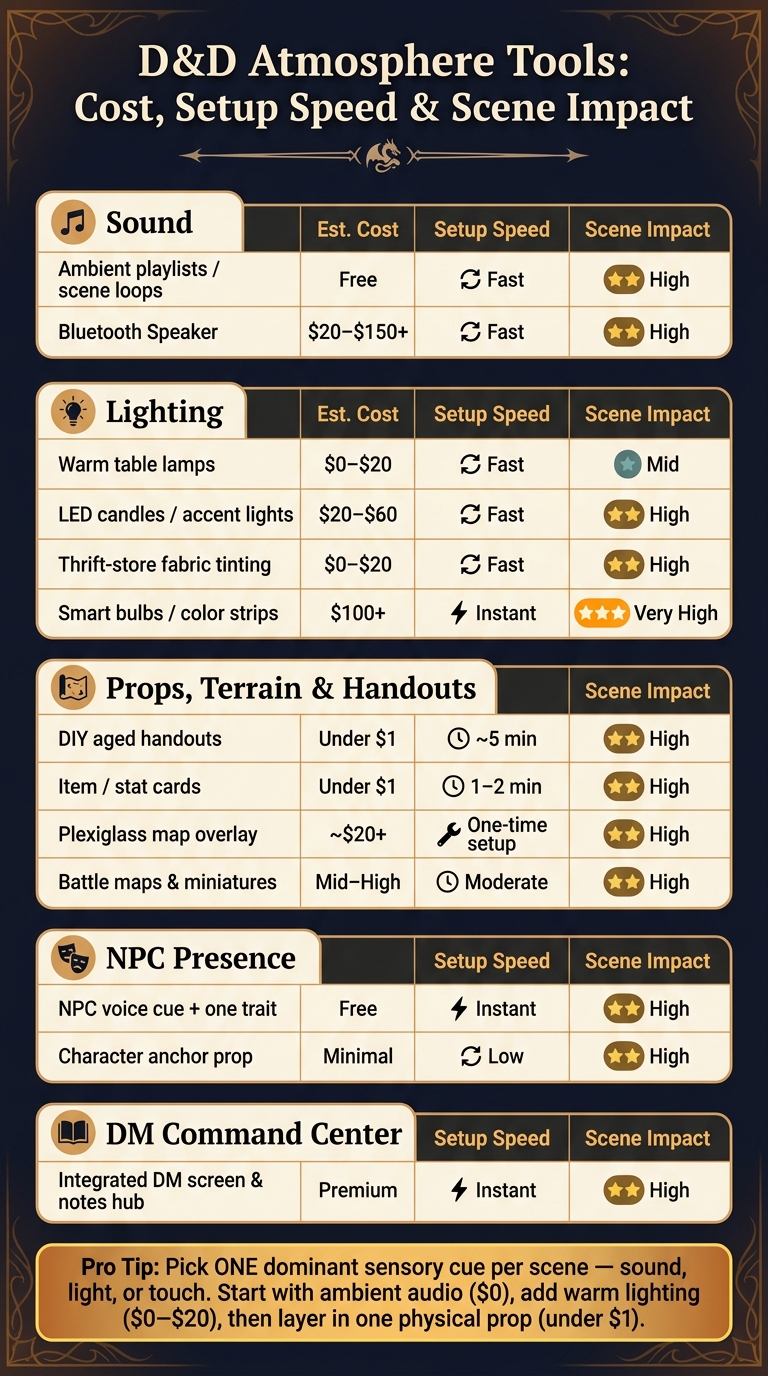
D&D Atmosphere Tools: Cost, Setup Speed & Scene Impact
If the earlier sections covered the how, these tables are the fast pick. Stick with one main sensory anchor for each major scene, and keep the setup simple enough that you can trigger it on the spot.
| Sound | Est. Cost (USD) | Setup Speed | Scene Impact |
|---|---|---|---|
| Ambient playlists or scene loops | Free | Fast | High |
Sound shifts the room first. Lighting changes how that room feels.
| Lighting | Est. Cost (USD) | Setup Speed | Scene Impact |
|---|---|---|---|
| LED candles or accent lights | Low | Fast | High |
| Warm table lamps | Low | Fast | Mid |
| Smart bulbs or color strips | High | Instant | Very High |
| Open-flame candles | Low | Slow | High |
| Props, Terrain, and Handouts | Est. Cost (USD) | Setup Speed | Scene Impact |
|---|---|---|---|
| DIY aged handouts | Free | ~5 min | High |
| Battle maps | Mid | Moderate | High |
| Miniatures | Mid–High | Moderate | High |
| NPC Presence | Est. Cost (USD) | Setup Speed | Scene Impact |
|---|---|---|---|
| NPC voice cue + one trait | Free | Instant | High |
The last layer is DM-side control: one place for notes, tools, and pacing.
| DM Command Center | Est. Cost (USD) | Setup Speed | Scene Impact |
|---|---|---|---|
| Integrated DM screen and notes hub | Premium | Instant | High |
Next, match these tools to the limits of a U.S. home game: space, outlets, storage, and table size.
Keeping It Practical for U.S. Home Games
Most D&D sessions happen at a dining room table, in a basement, or in some other room that has to do double duty. The good news is these tools still work in small home setups. The trick is making the room support the game without swallowing the table.
In tighter spaces, keep it simple and use one cue per scene: sound, light, or touch. Let the map, DM screen, and dice stay the brightest things in view, and let the rest of the room fade into the background. Turn off the overhead light and bring a warm lamp closer to the table [3]. That small shift pulls attention toward the game and helps the room feel less like a place for dinner and more like a place for adventure.
For sound, stick with the same scene-based approach, but keep the volume low enough that everyone can hear each other clearly [2].
Use the same core ideas, then fit the gear to the room you actually play in.
| Tier | Est. Cost (USD) | Lighting | Sound | Props |
|---|---|---|---|---|
| Budget | $0–$30 [5] | Warm household lamps, overheads off | Free playlists | Coffee-stained handouts, index cards |
| Mid-Range | $30–$150 [7] | LED strips or fairy lights | Soundboard app | Themed candles, neoprene battle mat |
| Premium | $150+ [7] | Smart bulbs programmed to scenes | Dedicated soundboard | Gemstone dice, modular terrain |
When it comes to props, compact and reusable wins. Pick items that fit on a small table and don't eat up play space. A sheet of plexiglass over the battle map gives players room to mark routes with dry-erase markers and keeps the map reusable, which saves space at the table [3].
It also helps to keep the DM side clean and fixed in place. When notes, tables, and tools all live where you expect them to, you spend less time digging around and more time running the scene. The result is a setup that stays easy to read and easy to use from one session to the next.
Conclusion
All of these tools serve one purpose: pull players out of the dining room and into the scene.
That feeling doesn’t come from one big trick. It comes from small choices you can repeat each session - a dimmed lamp, a steady playlist, a handout players can actually hold.
Start simple. Pick one change for your next session - lighting, sound, or a tactile prop - and add more later. Once the first step feels natural, bring in the next layer.
The aim is simple: make the room feel like part of the adventure. Use what works for your table, skip what doesn’t, and keep the focus on the scene. Let the room back up the story, and the story will carry the rest.
FAQs
What should I try first on a small budget?
Start with small sensory shifts that cost almost nothing. Skip the harsh overhead light and switch on one or two warm lamps, or light a few candles, to make the space feel more focused and a little more intimate.
Then add a coffee- or tea-stained note on printer paper with torn edges. It gives the setup a worn, lived-in touch. For background mood, play ambient music at low volume so it supports the scene instead of pulling attention away.
How do I add atmosphere without distracting players?
Use atmosphere with subtlety and restraint. Pick one main sensory anchor for each major scene, like a background track or a single prop, so the space doesn't feel cluttered. Keep music and sound effects in the background. If you notice them right away, they're probably too loud or too busy.
For lighting, skip theatrical blackouts. Small shifts, like dimming overhead lights and turning on warm lamps, tend to work better. Keep your setup consistent and low-tech so it doesn't interrupt the moment.
What works best in a small home game room?
In a small home game room, the goal is simple: cut distractions and keep everyone in the same shared moment. Start by clearing clutter. A crowded room pulls attention in too many directions.
Your table matters too. Pick one that gives people enough space to sit without feeling squeezed. That helps avoid awkward seating, side chatter, and the kind of split conversations that can break the mood.
Lighting does a lot of heavy lifting here. Warm lamps usually work better than harsh overhead lights if you want the room to feel close, calm, and a bit more intimate.
For sensory tools, keep it simple. One main element is enough. That could be subtle ambient sound or a single scent. The point is to support the atmosphere, not take over the room.