
If I want my lore to stay straight at the table, I need to track where each myth comes from. This article shows 10 source types I can note fast during play, how to keep each note short, and how to separate rumor from truth so I don’t stall the session.
Here’s the core idea in plain English:
- I log myths by source
- I keep each note to 6 fields
- I sort notes by use at the table
- I link one source to another so lore doesn’t feel random
The 10 myth sources covered are:
- Tavern tales
- Fireside legends
- NPC-carried rumors
- Roadside shrines
- Public symbols
- Scarred landmarks
- Annotated maps
- Inscriptions
- Letters and documents
- Family lines and living lore
A simple myth note should include:
- Source name
- Location
- What players hear
- What is true
- What is off
- Current hook
That setup does 2 jobs at once: it keeps my session notes short, and it helps me answer player questions on the spot. In practice, that means I can glance down and know whether a “dragon under the hill” is a beast, a lie, or just steam from a buried volcano.
Dael Kingsmill's Tips for Building Mythology | D&D Beyond
sbb-itb-74d578b
Quick Comparison
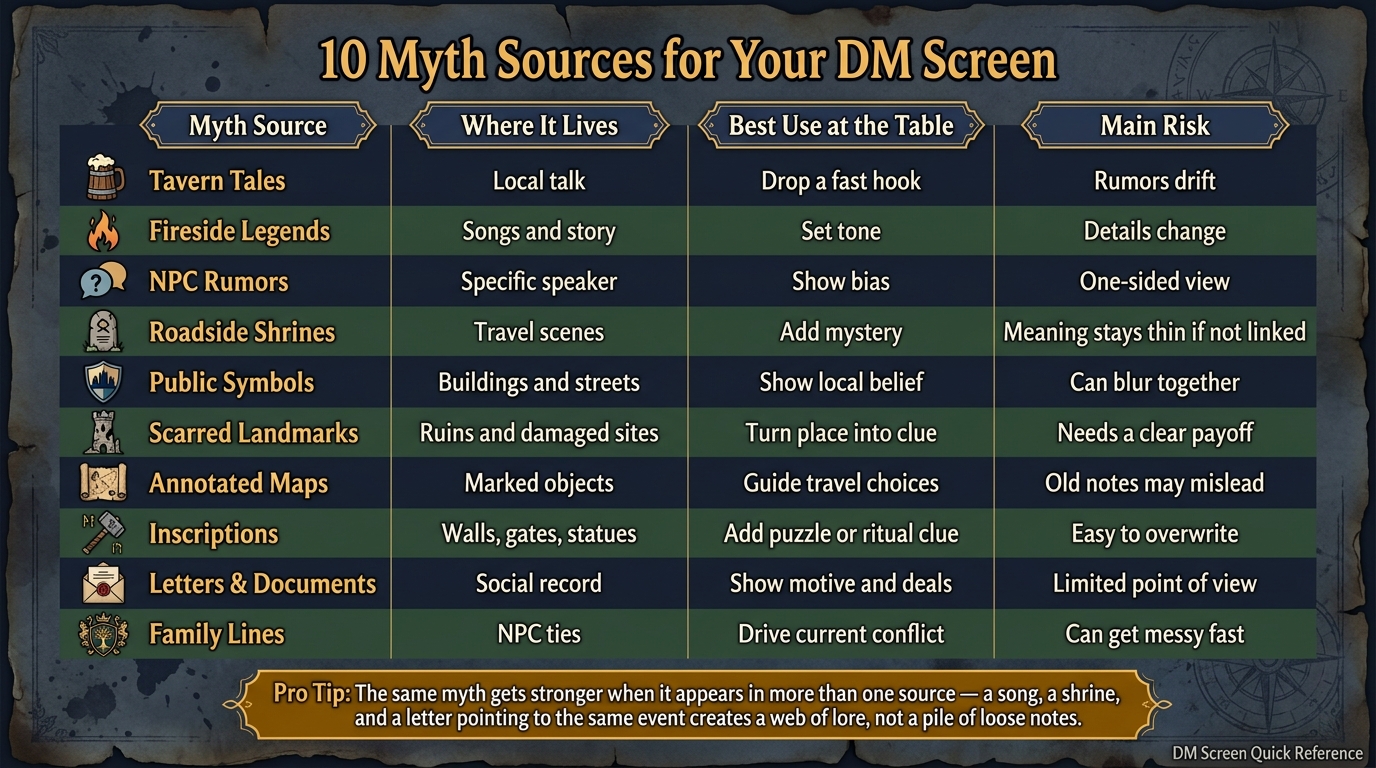
10 Myth Sources for DM Screen Notes: Quick Reference Guide
| Source | Where it lives | Best use at the table | Main risk |
|---|---|---|---|
| Tavern tales | Local talk | Drop a fast hook | Rumors drift |
| Fireside legends | Songs and story | Set tone | Details change |
| NPC rumors | Specific speaker | Show bias | One-sided view |
| Roadside shrines | Travel scenes | Add mystery | Meaning stays thin if not linked |
| Public symbols | Buildings and streets | Show local belief | Can blur together |
| Scarred landmarks | Ruins and damaged sites | Turn place into clue | Needs a clear payoff |
| Annotated maps | Marked objects | Guide travel choices | Old notes may mislead |
| Inscriptions | Walls, gates, statues | Add puzzle or ritual clue | Easy to overwrite |
| Letters/documents | Social record | Show motive and deals | Limited point of view |
| Family lines | NPC ties | Drive current conflict | Can get messy fast |
One useful pattern runs through the whole piece: the same myth gets stronger when it shows up in more than one source. A song, a shrine, and a letter that all point to the same event give me a tight web of lore instead of a pile of loose notes.
What Makes a Good Myth Note Behind the Screen
A myth note belongs behind one of the best DM screens only if you can use it in the middle of a session. That means it should be short, consistent, and easy to spot at a glance. If you have to stop and read a full paragraph, it’s probably too long.
A simple way to keep things clean is to use the same six fields for every source.
| Note Component | Purpose | Quick Example |
|---|---|---|
| Source Name | Origin | "Elder Kaelen", "The Sunken Tablet" |
| Location | Where it's found | "The Whispering Woods" |
| Myth Summary | What players hear | "A dragon sleeps beneath the hill." |
| What Is True | The truth | "It's not a dragon; it's a dormant volcano." |
| What Is Distorted | Distortions | "The 'smoke' is steam, not breath." |
| Play Hooks | Current hook | "Local tremors are getting worse." |
This setup keeps rumor and truth separate, which matters a lot at the table. You can see what NPCs believe, what the players hear, and what’s actually going on without digging through clutter.
After that, make the notes easy to scan. Tags and color-coding can do a lot of heavy lifting here. For example:
- Mark live leads with Active or Rumored
- Move settled lore into Completed or Dead
- Keep separate pages for recurring people, places, and monsters
And one more thing: use fragments, not full prose. Think quick-reference notes, not polished writing. For example: "Bell, half-elf fence, docks, owes party."
1. Oral Traditions
Spoken lore is one of the easiest ways to drop in adventure hooks. Think songs, tavern rumors, and fireside warnings that NPCs already buy into. These myths move from person to person long before anyone writes them down, so they’re often the fastest ones to use at the table.
Here are three oral tradition types worth tracking behind your screen:
- Tavern Tales and Local Gossip Keep each rumor short, local, and easy to improvise.
- Fireside Legends and Hero Songs Use a short verse or rhyme to set the mood and hint at a ritual.
-
NPC-Carried Rumors
Track each NPC’s version apart from the truth. Write the speaker’s name next to the rumor so bias is easy to spot. A quick note like
Bell, half-elf - knows the "Drowned King" legend[3] ties the myth to a speaker, not a summary.
When a new legend shows up, jot down a one-line stub. Then mark it as established lore once it becomes true at the table.
Oral myths often point toward a place, object, or bloodline - the next kind of source to log behind the screen.
2. Sacred and Public Sites
Where oral lore lives in people, site lore lives in place. A place carries myth through scars, rituals, and local memory, and players tend to pick up on that right away.
Here are three site types worth tracking behind your screen:
-
Roadside Shrines
Small and easy to drop into almost any travel scene. Focus on the custom and leave the reason unstated:
Shrine by the Ford - iron nails, not coins. Locals won't say why.[4] - Public Symbols and Marked Buildings Divine icons carved into doorways show folk faith alongside formal temple worship [5]. Track three things: the symbol, the building, and the belief tied to it.
- Scarred Landmarks and Ruins A burned bell tower or a collapsed bridge holds a local memory that still shapes behavior [4]. The myth shows up in what people fear, avoid, or guard. Treat each landmark as a clue, a warning, or an obstacle the moment the party arrives.
For any site, note the scar, the memory, and the action it opens up: scout, investigate, or avoid the danger.
When a place keeps coming up in rumor, it becomes much easier to connect it later to records, relics, or bloodlines.
3. Recorded and Material Evidence
If oral lore lives in people and site lore lives in place, recorded evidence lives in objects. And those objects never come to you clean. They carry history, point of view, and blind spots.
Keep these three on your screen:
- Annotated Maps Use the marked-up version, not the neat one. A worn map with handwritten notes like "Ruined Tower" and "Stockade" shows earlier hands at work and the judgments those people made [2]. Pay attention to the notes, the owner's take on what they saw, and the route the map quietly pushes the party toward.
- Inscriptions and Carvings Text cut into a crypt gate, a statue base, or a dungeon wall can do more than set the mood. It can act as a puzzle piece or a ritual key [2]. A carved phrase, for example, might hide a clue once players rearrange it. Track where it appears, the exact wording, and what secret it opens.
- Letters and Social Documents A letter can serve as a myth source because it records trust, motive, and betrayal [2]. Look at who issued it, who received it, and who the document binds, deceives, or sells out.
These pieces land best when they come with bias baked in: the mapmaker's fear, the cult's code, the noble's self-interest.
Once records move from an archive into family memory, they turn into inherited lore.
4. Inherited and Living Lore
Family history turns into living myth when the people at the table start pulling on it. The most useful inherited lore is the relationship web: kinship, debts, rival claims, and secret bargains that connect your NPCs right now.
Skip the full biography in your notes. For each key NPC, write down three things: one clear motivation, one faction tie, and one secret they're hiding [4].
That keeps the lore active, because it can change as play moves forward. When something becomes canon, mark the change in a single line.
Keep each entry short so it's easy to use at the table.
Simple Ways to Organize Myth Sources During Play
Once you've logged your sources, sort them by how you'll use them at the table. The point is simple: fast access when players throw you an unexpected question.
A good way to do that is to split your myth notes into two layers: a quick-reference screen insert and deeper lore in your journal or a separate file.
The screen insert should hold only the facts you need tonight. Your journal can carry the rest.
It also helps to group sources by region, so nearby songs, shrines, maps, and family lines stay in the same place. If the lore starts getting messy, add confidence tags like Extracted, Inferred, or Ambiguous [1]. That makes it easy to see what a source says outright, what you've pieced together, and what still feels uncertain.
Done well, any myth source is only one glance away when the party suddenly heads in that direction.
Conclusion
Fantasy starts to feel real when the same myth shows up in more than one place: a song, a shrine, a relic, a family line. Each legend leaves traces behind. Tracking where those traces live is what keeps your lore steady from one session to the next.
When you sort notes by source type and link them together, scattered bits of lore become a web you can actually use. That's the key. One source only does so much on its own. It becomes far more useful when it points to something else.
That web pays off the second players ask a question you didn't see coming. You check the note, find the link, and keep the scene moving. Good myth notes keep lore connected, easy to search, and ready when you need them.
FAQs
How do I keep myth notes from getting too long?
Keep myth notes short. The goal is easy recall, not a giant archive. Use fragments instead of full sentences, and write down only the facts you can scan in a second, like a name, origin, or key trait.
Don’t build out pages you’ll never touch at the table. Organize notes by entity, not by timeline. Then connect related myths, NPCs, and locations with simple bullets. If something starts to matter in play, that’s the time to add more.
Which myth sources work best for improv?
For improv, the best myth sources feel more like gossip, rumors, or half-remembered warnings than dry history. You want the kind of details that change what players do right now: local superstitions, old feuds between nearby places, or that one event everybody brings up as if it explains everything.
Keep your notes light and easy to scan. A one-line fact, a key rivalry, a warning, a family tie, that’s often enough. Speed matters more than completeness. Build out deeper lore later, when the campaign gives you a reason to.
How do I connect rumors to the real truth?
Treat each rumor as an unverified lead, not just flavor text. In your notes, tie it to a specific person, place, or clue. Then track two things side by side: what the players think is going on, and what’s actually true behind the scenes.
Use steady cross-references so each rumor points to evidence such as letters, carvings, or NPCs. That way, the thread doesn’t just hang in the air. It connects to something the players can check, question, or chase down.
When players act on a rumor, give them a consequence or a clue that pushes it forward. Maybe they find proof. Maybe they stir up trouble. Maybe they learn the rumor was half-right in the most dangerous way. The point is simple: a rumor should turn into an actionable plot point, not stay as background color.